Enjoy 10% off your first Fine Art print by signing up for the newsletter.

Why You Should Not Buy AI Generated Prints
Why You Should Not Buy AI Generated Prints
What the NFT collapse taught us, and what a photograph still does.
In March 2021, Christie’s auctioned a JPEG called Everydays: The First 5000 Days by the artist Beeple for sixty-nine million dollars. The buyer received a string of characters on a blockchain. Within two years the broader NFT market had collapsed by more than ninety-five percent in average value. The same JPEG, today, is worth the price of a coffee. When it sells.
There is a lesson in that sentence, and it is not a technological one. It is the oldest lesson in art collecting: an object without a soul will not hold its value, no matter how loudly the market insists.
The same lesson is now arriving at our doorstep with AI-generated prints.
What an AI image actually is
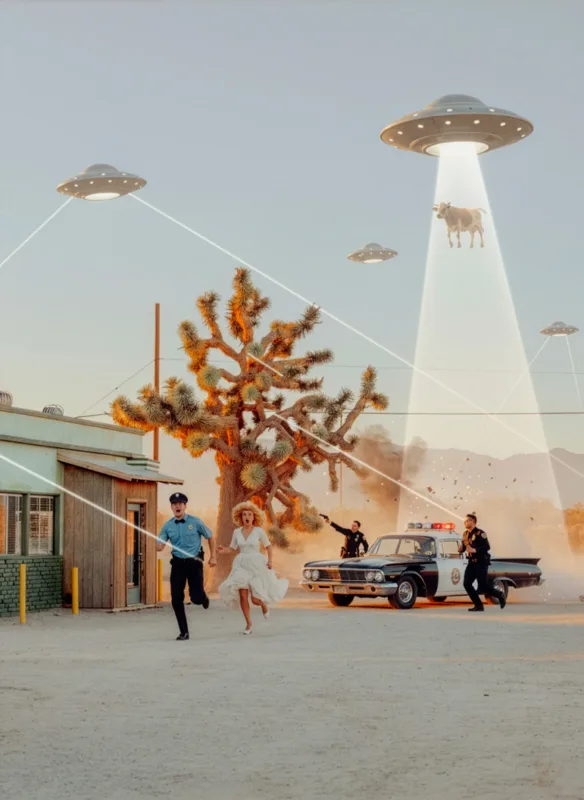
When you ask a model to generate an image of a swimming pool in Palm Springs at sunset, the machine does not go to Palm Springs. It does not stand in the heat. It does not wait for the right hour, the right cloud, the right shadow to fall across the diving board. It searches its training data, finds a statistical average of every image it has ever been shown that resembles “swimming pool, Palm Springs, sunset,” and produces something that looks like the consensus of those images.
There is no encounter. There is no decision. There is no time. There is no place. There is no body in the world doing the looking.
What you receive on paper is the visual equivalent of a sentence written by a calculator: technically correct, statistically plausible, and entirely unwitnessed.
What a photograph actually is
A photograph is the opposite. It is, by its nature, the trace of an encounter. Someone was there. Someone chose to stand at this corner, at this hour, on this morning, for reasons that may not be entirely clear even to them. Someone waited. Someone framed. Someone pressed.
That presence is the entire content of the medium. The French critic Roland Barthes called it the that-has-been: the photograph’s most fundamental claim is that this thing was here, in front of a person, at a moment that will never return.
An AI image cannot make that claim. It can imitate the look, the grain, the color cast. It cannot imitate the having-been-there.
This is not nostalgia. It is the structural difference between a record and a synthesis.
The NFT lesson, in plain language
The NFT bubble was instructive because it tested, with real money, the proposition that a digital image alone, divorced from any physical or experiential anchor, could function as a collectible asset. The market said yes, briefly, at the height of the speculative wave. Then it said no, decisively, when the speculation ended.
What collapsed was not the technology. The technology still works. What collapsed was the assumption that ownership of a generated or replicable image, with no soul behind it, constituted a valuable thing.
AI-generated prints are walking into the same trap, in physical form. The image is impressive on a phone screen. It looks reasonable on a wall. But the moment a collector asks the question that every collector eventually asks, who made this, and why, and was anyone there, the print has nothing to answer with.
The eye that cannot be replicated
There is something a model cannot copy, no matter how many billion images it ingests, and that is a single human eye returning to the same subject for years, deciding what it cares about, refusing to photograph what it doesn’t.
A photographer’s signature is not a graphic style. It is a long catalogue of choices: which corner to stand on, which hour to wait for, which light to refuse, which subject to come back to seven years later because the first photograph was wrong. That accumulated decision-making is what makes a body of work coherent, and what makes a single print belong to it.
When you buy a fine art print, you are buying the result of a specific morning, a specific afternoon, a specific moment when one person decided this frame was the right one. The print is a piece of that decision. The certificate of authenticity is a piece of paper. The decision itself is the actual asset.
A model has no decision. A model has a probability distribution.
The collector’s logic
The art market has always rewarded scarcity, intentionality, and provenance. AI prints fail all three.
Scarcity. The same prompt can generate ten thousand variations. There is no edition because there is no original.
Intentionality. The model has no preference. It does not love the morning light. It does not return to the same building.
Provenance. The chain of decisions behind the image is empty. There is nothing to attribute, nothing to authenticate, nothing to certify in any meaningful sense.
This is why secondary markets for AI prints do not exist, and why they will not exist in the way they exist for photography. The first wave of buyers may pay. The second wave will not.
What you are actually buying
When a print enters your home, you are not only buying an image. You are buying the fact that someone went to make it. You are buying the time, the distance traveled, the hour waited for, the choice that nobody asked for. You are buying, in a real sense, a fragment of someone else’s attention.
That fragment is what makes a print last on a wall and last in a market. It is the only thing that does.
The NFT collapse should have taught us that no amount of technological packaging can substitute for that fragment of attention. The AI print wave is repeating the same mistake, in higher resolution.
Buy the eye. Buy the morning. Buy the decision.
The image is the proof, not the asset.
Discover , signed and numbered, made on location across Palm Springs, New York, Paris, Miami, and the California coast.